
In my first year of teaching, I had a ninth grader my family still talks about. She was a hard case, but we made it through with the grace of God.
Once you got past her overall aggression, well, I won’t exactly say she was a sweetheart, but she was funny, and so far as I was concerned, that was even better.
In the course of writing a paper, this student called me over to read her writing. In her work, she used the word ‘big,’ approximately 15 times in one paragraph. It was aggressive, but she didn’t have the vocabulary to extend beyond ‘big.’
I tried to explain to her that she needed some different words other than big:
Me: “Alright, so why don’t we use another word than big here.”
Student: “Okay.” *Poises hands above the Chromebook. Looks up at me.*
Me “…”
Student: “…”
Me: “…”
Student: “So, what’s another word for big?”
Me (thinking this is a great teaching moment): “Why don’t you come up with one? Try looking it up.”
I told her to use synonyms.com.
I continued circling the room, and I largely pushed the conversation out of my mind.
Excitedly, she called out later in class, “Miss Meadows, come see what I got!” She was glowing with pride. She pointed to a sentence, and I kid you not, it read:
“She had a brobdingnagian problem.”
I was floored. Honestly, for a split second, I considered explaining to her how we don’t want to make it obvious we’re using synonyms.com. Saying this almost seemed like a good idea.
Almost. Instead, you know what I said?
“Great job! That’s an incredible word!”
Because honestly? In the grand scheme of things? I learned how to pick my battles.
There is a similarity to be found here with AI.
It’s a tool: largely, at this point, it’s amoral. In many cases, I think it can be a good tool: I certainly use it.
Our trip to Italy largely came from AI. I input our standards into AI, and I ask for the best way to approach different things I struggle with, such as teaching grammar.
I used AI this past week to find the best way to make and can spaghetti sauce. But AI cannot face off and win against my Gran’s knowledge.
And I think that lack of connection is one thing I worry about: I worry that society, specifically this next generation, will continually turn to technology for answers, rather than trusting the advice of people around them.
And make no mistake: our experience is meant to teach us personally, as well as teach those around us.
AI is a tool: nothing more and nothing less. But I do think it’s an outsized tool for kids and teenagers. It’s kind of like asking them to kill an ant and giving them a grenade to do so.
They are wholly unprepared to wield such a tool and unequipped to determine what task the tool best fits.
Naturally, the argument would be to teach them how to use it. Honestly? I’m not even sure I know it well enough to teach how to use it in the first place.
Technology has changed drastically since I was in high school.
When I began teaching in 2017, AI wasn’t really a familiar concept. The closest version we had of that was I Robot, and for any Will Smith fans, we know that didn’t turn out so well.
But teaching in a classroom only four years after I’d graduated was radically different than what I’d experienced. When I went to school, there were a couple desktops in the lab, but mostly, we wrote papers by hand.
When we needed to do a research project, we went down to the computer lab. We wrote down sources on index cards and had to go through the arduous process of putting those sources into MLA format.
Point that must be made? Teaching MLA format is even less fun to teach than it is to learn.
Now, I’m waxing spiritual about this, but many of you can remember using only print sources to write papers. We did that in part, but mainly as supplements to what we could find online.
Here’s what I worry about with AI:
I worry students won’t arrive at their own conclusions.
I worry students won’t do the hard work to make progress and arrive at the end goal.
I worry students won’t make and, therefore, learn from their mistakes.
I worry students won’t be able to tell the truth from fiction.
I worry that students’ research will be reduced down to the first blurb they see when they Google a question.
And it should be said that, as an English teacher, I’m biased: I’ve seen my fair share of essays written by AI. They’re obvious, as it’s hard to make a machine sound like a student, especially when that machine writes on a college-level and ninth graders decidedly do not.
Ninth graders don’t use words like ‘obfuscate,’ ChatGPT.
What I worry the most about?
I worry AI will end up forcing our creativity out of us.
Case in point? AI advertisements. They all look the same: initially, they looked great. The look of the advertisements were new: there was a novelty there.
However, now, all infographics made with AI look the same. There’s a similarity and a polish to them that doesn’t come with work that’s human-generated.
Now, that in and of itself isn’t a bad thing: AI allows us to save time, and we’re all busy people. We’d prefer not to spend an hour or two making an infographic if we can help it.
I don’t blame you a bit for saving time.
But is there a line there? What’s the point where we decide that creating something is worth the time it takes? That producing something novel is worth extra time?
I promise you I’m not trying to be a downer: this is genuinely a question I’m wondering.
After all, being creative isn’t an easy thing: that’s why it’s impressive.
That’s why we’re in awe when we see extreme creativity. Case in point?
I will always think J.K Rowling’s Harry Potter series is one of the most creative modern-day works of art we have.
What I was most impressed by was her creation of the dementors: these were beings dressed in black that literally sucked the life out of people. This was her representation of what depression feels like.
That’s symbolism created from lived experience: you cannot get that from artificial intelligence.
Creativity is hard.
It is arduous. It is a choice. It makes us better human beings.
I worry that we all will stop doing the work of being creative because there is an easier way.
For me, the hardest thing to teach? It’s writing.
It’ss tedious, and it’s the culmination and application of everything you learn in an English classroom: grammar, mechanics, structure, and above all else, interesting ideas.
You cannot fake good writing.
It’s particularly difficult when you’re attempting to teach a student who doesn’t read well.
All things coming together in one writing? It’s tough.
But it’s also rewarding, building a student’s ability to make connections and think critically.
Another reason for my concern?
I think creativity and, as a result, creation, is one of the highest forms of worship. Made in the Image of God- the God who is the ultimate Creator-, we are designed with an itch to create.
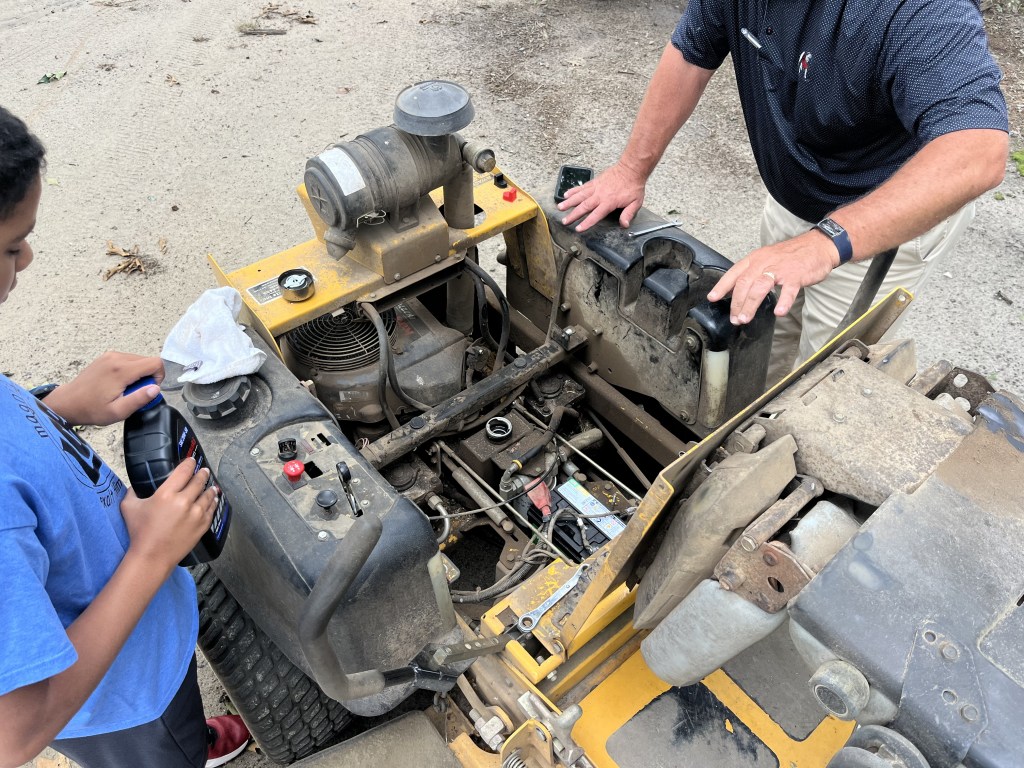
This looks differently for each of us: for some, it’s cooking, and for others, it may be painting. It could be gardening, troubleshooting tractor issues, welding metal, or designing the interior of a home.
Bypassing that is unintentionally pulling us from the Creator: it’s pulling us away from worship, as well as cutting out human error.
The small imperfections in our creativity give a human stamp to what we do, which makes what we invest in interesting.
I’m not much of an NFL fan, but I adore college football. I love the bigger margin of error in college football: it makes college football more interesting to me.
The element of human imperfection reminds us that we aren’t God. AI suggests that we are: that there is a way to bypass human error. We aren’t perfect, and there is nothing in human existence perfect.
AI in and of itself is not perfect: it is not creative. Rather, artificial intelligence is pulling from already created sources. But we are apt to say it’s, in and of itself, creative. Why? Because it’s fast.
AI Might be our own Tower of Babel.
Maybe technology as a whole is. Building a tower, in and of itself, isn’t a big issue. But building that tower out of self-sufficiency is.
The ability to build points to God Himself- to the skills and ability He gives us. Building it to reach to God is a different beast: it puts us (in our human minds) on level with God. Our flesh desires that, whether we recognize that or not.
Which, really, the punishment still exists: we’re now speaking a different language, much as they did. It’s harder for the kids to talk to adults now.
There is an aggression to talking about politics that didn’t exist before.
I attribute that largely to technology.
Maybe I’m just sounding the alarm at something that doesn’t need it.
I guess I don’t worry about AI taking over the world. It may. Here up front, though, I worry about lack of motivation from kids. I worry about lack of error because there is a lack of trying.
I worry students will lose their creativity, and this is heartbreaking: kids have a lot of creativity to add to the world.
There are skills to learn in creating, and there are skills to be learned in making mistakes.
I don’t want this next generation to lose out on that.
AI is a good tool, for sure. But it’s necessary we teach the ways to use it and also remind ourselves it’s not the fix-all.





 Easily Excitable
Leave a comment